Instruments With a Story

The singing bowls I use today have been part of my personal meditation practice for almost three decades.
I purchased them in Dharamsala, India, in 1997 while on pilgrimage, attending teachings by His Holiness the Dalai Lama and travelling throughout the Tibetan Plateau, deepening my exploration of Tibetan Buddhism, shamanism, yoga and other Himalayan spiritual traditions.

My Tibetan bell came home with me from Lhasa, purchased in the bazaar surrounding the Jokhang Temple, near the Potala Palace, during the 1996–1997 Tibetan New Year period.
The Jokhang is regarded as one of the most sacred sites in Tibetan Buddhism. Within Tibetan sacred tradition, it also occupies the center of an ancient story in which the landscape of Tibet is envisioned as a great demoness whose energies were subdued as Buddhism became established there. Within this sacred geography, the Jokhang sits at the heart of the demoness, with a wider network of temples traditionally understood to pin or subdue points across her body. For me, this gives this bell a particular significance — a connection to that sacred heart, to the source, and to the birth place of the spiritual traditions from which it came.

I brought these instruments home with me and have continued to use them in my own meditation practice for nearly 30 years — as a way of gathering attention, developing one-pointed focus and allowing resonance to wash through the senses until distraction begins to fall away.
They are not decorative objects in my practice, nor instruments I recently acquired to offer a wellness service.

What Does a Sound Bath Actually Look Like?
There is nothing you need to accomplish during a sound bath. The invitation is simply to become comfortable, listen and notice your own experience as sound moves through the space and eventually returns to silence.
1
Arrive
We begin by settling into the space and allowing some of the activity and distraction of the day to recede.
2
Listen
Singing bowls and resonating bells create sustained tones that move through the space, giving attention something simple and immediate to follow.
3
Notice
Different tones can feel remarkably different from one another. Rather than deciding what you should experience, the practice is to notice how you respond to sound, resonance and silence.
4
Return
As the final sounds disappear, we allow time for quiet before returning to ordinary activity — noticing what, if anything, has shifted in our attention or awareness.
Sound baths may be experienced individually or incorporated into small-group gatherings, meditation, yoga, contemplative practice and other intentional mindfulness experiences.
No Two People Hear Quite the Same Thing
While on pilgrimage in Tibet, I was told by the nomads I was travelling with that a bell that resonates beautifully for one person may sound or feel quite different to another. Their explanation was partly physical: the unique shape and curvature of our skulls and bodies affect how resonance is experienced. Just as no two heads are exactly alike, no two people experience these vibrations in precisely the same way.
Whether understood spiritually, acoustically or simply through personal experience, the idea has stayed with me because it points toward something much larger about perception.
We don't simply hear sound. Our brains make sense of vibration.
Something similar happens with colour. An object does not contain “red” or “blue” in the way we experience those colours. Light reaches our eyes, sensory information travels to the brain, and the brain creates the experience we call colour. Our experience of our own bodies is also constructed from signals continually being interpreted by the brain.
In that sense, two people can stand in exactly the same place, hear the same sound and witness the same event, yet have remarkably different experiences of it. One may experience uncertainty as threatening; another may meet the same uncertainty with curiosity. The situation can be identical while the experience is very different.
This doesn't mean our experiences are imaginary, or that difficult circumstances can simply be wished away through positive thinking. It means there is a relationship between what happens and how we experience what happens — and that relationship is something we can learn to notice.
For me, this is part of the value of working with sound, meditation and attention. The sustained resonance of a bowl or bell gives us something simple to notice. We can observe where attention goes, what arises automatically, and what happens as the sound eventually disappears into silence.
Sometimes we discover that we aren't responding only to what is happening now. We are also responding through expectations, memories and patterns shaped by what has happened before. The circumstances around us may not have changed at all. But when our relationship to our experience changes, something important can change with it.
The Scent of Harmony

At Shamanic Forest Healing we also make own natural incense by hand, bringing together plants and materials gathered with ceremony from our old growth forest and sacred places and temples from around the world.
Our blends include sweetgrass grown in our garden, cedar respectfully gathered from the old-growth forest, makko bark collected in Japan, sage gathered in Kelowna, British Columbia, sandalwood from Australia, water collected during the last lunar eclipse and herbs collected at the Jokhang Temple in Lhasa during the 1996–1997 Tibetan New Year period.
Where they came from.
How they were gathered.
The intention with which they are brought together.
The ingredients are ground and blended by hand and combined with water gathered from the old-growth forest during significant natural moments — including water collected during the most recent lunar eclipse — to create incense for cleansing spaces and preparing objects and places for intentional and sacred practice.
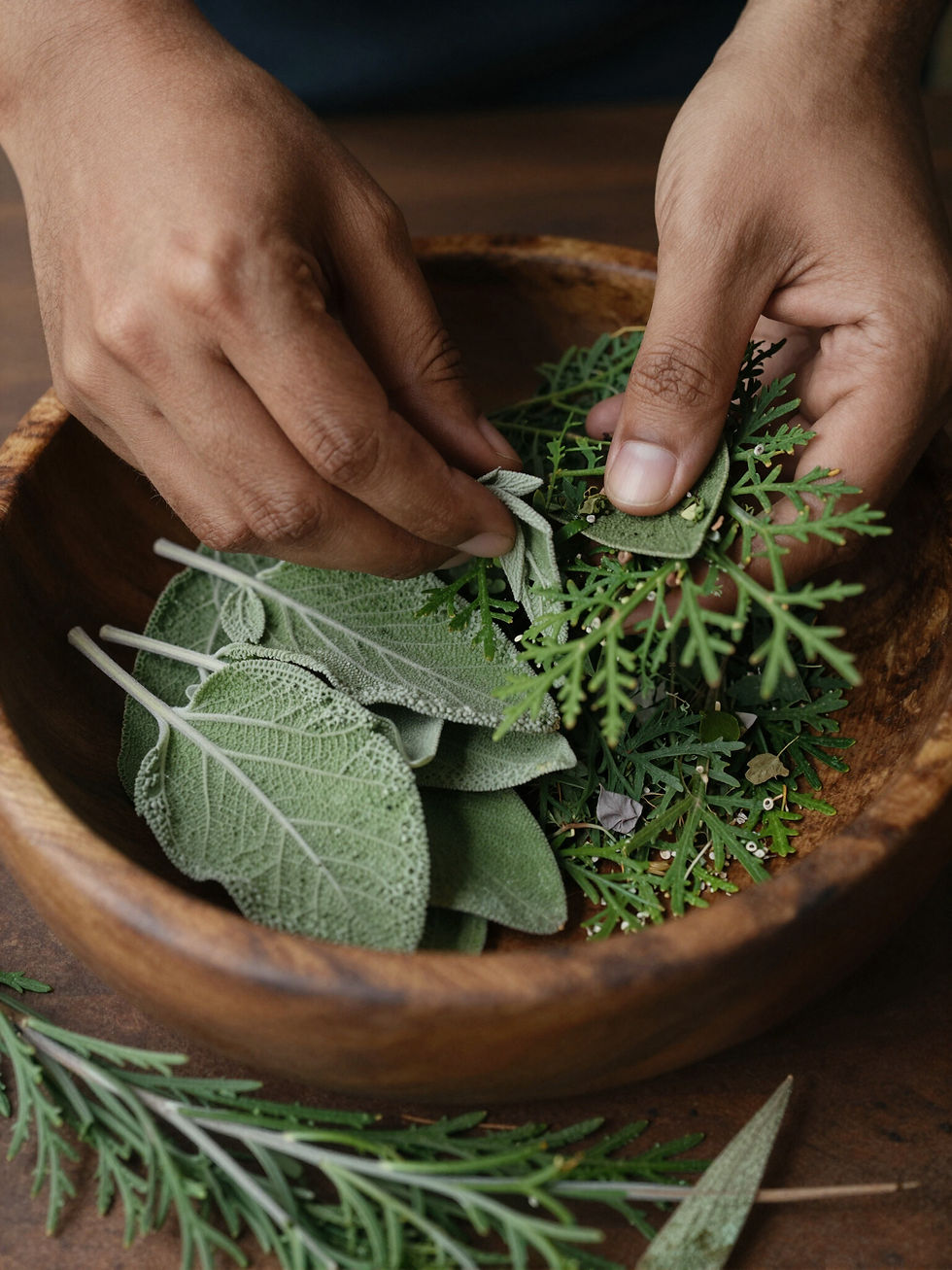
For me, the significance lies not simply in the individual ingredients, but in where they came from, how they were gathered, the experiences and places they connect to, and the intention with which they are brought together.

Cleansing & Preparing the Space
Clear what has come before.
Establish the space.
Become present to what comes next.
Sound can also be combined with smoke, scent and plant-based cleansing or smudging practices to intentionally prepare a space for what is about to happen within it.
I work with my own handmade natural incense, organically grown herbs and materials respectfully gathered from the forest, together with the sustained resonance of singing bowls and bells.
The intention is to mark a transition from the noise and activity of everyday life into a space created for attention, reflection and presence.
This can be particularly meaningful and a great way to create a protected envelope, setting the space and intention before meditation, yoga, tea ceremony, shamanic work and other contemplative or intentional practices.
Some people experience this as cleansing the energy of a space. Others experience it simply as a powerful shift in attention and atmosphere.
This helps create an inclusive environment without dogma. There is no particular interpretation you need to adopt.

From the Mundane to the Sublime
Bring significance to the ordinary.
Move from the mundane into the sublime.

Much of our day is spent moving quickly from one thing to another.
Intentional practices ask something different of us: that we become present.
Sound, smoke, scent and ceremony can help mark that threshold.
I use the sustained resonance of Tibetan singing bowls and bells together with natural incense and plant-based cleansing practices to create an intentional sensory environment — clearing away some of the noise and distraction of ordinary life and creating space for greater attention, clarity and awareness.
The intention is to bring significance to the ordinary — to mark the transition from the mundane into the sublime and create the conditions in which we may become more receptive to ourselves, to the natural world and, for those who understand it this way, to the sacred or divine.
Ways to Experience This Work
Sound Bath Experiences
Individual or small-group experiences using Tibetan singing bowls, resonating bells and silence to create an environment for listening, attention and contemplative practice.
Space Cleansing & Smudging
Intentional preparation and cleansing of homes, studios and other spaces using handmade natural incense, plant materials, smoke, sound and ceremony.
Ceremony & Contemplative Gatherings
Sound, incense and space preparation can be incorporated into meditation, yoga, tea ceremony, shamanic practice and other intentional gatherings to help establish a clear transition into contemplative space.
Every experience can be adapted to the people, place and intention involved. We can begin with a conversation about what you are hoping to create.
Begin With a Conversation
You don't need to know whether you are looking for a sound bath, space cleansing or something more personal.